Deconstructing Woodside Village

The other day I got an anonymous flier in our mailbox, addressed to “Westwood Resident.” Inside was an unsigned memo inviting us to a “town hall” meeting being held to inform people about a proposed mixed-use development called Woodside Village.

I’ve heard plenty about this from our neighbors, including my father, who is not a big fan of the idea. My dad and I don’t always agree on matters of public policy, but in this case we’re both highly skeptical about the proposed development. In fact, it was Jennifer and I who first brought up some of the questions to him that Westwood residents are now (or should be) asking themselves.

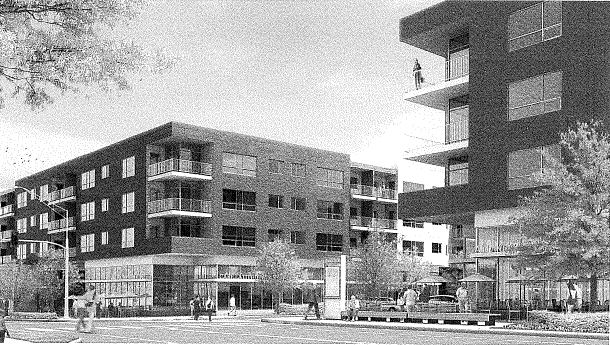
More about those questions in a moment. First, a bit of background. Woodside Village, according to the flier, is “a proposed multi-use development designed as a walkable and integrated open-air Village organized around the Woodside Health & Tennis Club, 330 luxury residences, a 35,000 square foot shopping center, and an energized public realm where citizens can gather and strengthen community bonds at events such as a weekly farmer’s market.”

For a community of 1,500 people, this is a pretty big deal. If all the units filled up, you’d be increasing the population by around one third. That in itself doesn’t bother me at all — a community needs to grow and develop or else risk getting old and outdated, like the Westwood Apple Market, which looks like a relic of the mid-eighties.

But are 330 luxury apartments and 35,000 feet of commercial space really what this market is calling for? We’ve already been through this in Kansas City, Missouri, where thousands of condominiums were renovated and made available to a buying public that never showed up. Many of these places are now on the market as apartments and still remain vacant. Nearer to Westwood, places like the recently developed luxury spaces at 47 Fisher can’t even manage to attract rental tenants for a handful of units.

As someone currently looking for a place to buy or rent, the word “luxury” is a big turn-off. What’s wrong with “attractive and well-constructed” or even “affordable”? If I were in the market for luxury digs there would already be hundreds of other places to look in areas more exciting than Westwood. Sure, Woodside draws a pretty good crowd to the pool on weekends, but I doubt it’s enough of a buzz to fill up hundreds of luxury apartments. Just my gut reaction there.

The man behind Woodside Village is Blair Tanner, a Los Angeles-based real estate developer who owns the health club. (To get an idea of the flavor and personality of the proposed community, you might visit this recent post by local blogger/personality, Craig Glazer, who gushes that the city is “poised to green light the project.” News to me.)

The mentions of farmer’s markets, heavily landscaped pathways, and LEED certified buildings sounds attractive, but let’s not mistake this for a public urban development — as the flier itself states, “Woodside Village is proposed to coincide with the expansion of Woodside Health & Tennis Club.”

My question is, do we really need Woodside Village to bring us farmer’s markets, community gatherings, green initiatives and “heavy” landscaping? Isn’t framing Woodside Village as a community initiative and not a commercial venture at least a little misleading? I grew up in Westwood and am living there again temporarily, and the neighborhoods seems pretty alive and well to me without needing to artificially create a whole new upscale sub-community owned by someone in L.A.

My biggest question is how much the city will be on the hook for Woodside Villiage when (sorry, if) the proposed luxury units fail to sell. As a taxpayer in KCMO for the past five years, I’m happy to be contributing to city services there and wish we had the kind of police protection and public works that Westwood, KS enjoys. But I’m not at all happy about the taxpayers footing a huge chunk of the bill for the money-sucking Power and Light district, a centerpiece of the heralded downtown renaissance that our civic leaders at the time convinced us would be a lucrative, energized public realm. I’d hate to see the same thing happen to Westwood just because we got lured in by mentions of upscale condos, green building techniques and farmer’s markets.

A more relevant comparison would be the perpetually stalled mixed-use “Gateway” project in nearby Mission, Kansas, currently a wasteland where the mall used to be. Financially, how would TIF-seeking Woodside Village be any different? What’s changed in the economic climate in the last few years that will make hundreds of buyers of luxury residences suddenly materialize in northeast Johnson County? What happens if the project gets stalled or the developer foresees losses and backs out?

By the time these details are discussed at Westwood town call meetings (whether citizen-led or developer-sponsored), I will most likely be living in Missouri again, so I don’t really have a dog in this fight aside from my parents living there (and being a past summer employee of the public works department and recipient of the Westwood Foundation Scholarship in 1999). I care about the community and hope that the residents and council members can see past the buzzwords, potential profits and promises of luxury living in order to give the proposed plan the scrutiny it requires.

Sic Alps in the dark + life after the West Bottoms

Back in the day I used to go to an old warehouse in the West Bottoms to see shows. They didn’t cost much, the bands were good, and you could post up against the wall or on an old couch, set your six pack on the dusty hardwood floor and watch live music without the bright lights and antiseptic nonsmoking get-the-fuck-out-it’s-last-call atmosphere of a commercial bar.

I’m sure over the years I’ll remember those shows even more fondly, building them up in my head until the West Bottoms becomes my own personal Bowery or Manchester, but the moments in which I felt actual connectivity to the city or any kind of scene were relatively rare. Most of the time I just went with a friend or two or even by myself to drink whatever we brought with us and anonymously watch some of the best music you could find. One of those shows was the Sic Alps at the Pistol in January 2008. I found a video of that performance, which the shot above is taken from during a split-second camera flash.

As you can see, the space looks more like being backstage at an old theater than an actual venue. And as you can hear, it got fairly loud. (If you don’t like ambient noise than it’s probably best to skip to about 3:30 mark of the video for the song to kick in, one of my favorites by the group, as it turns out).

The last show I saw in the Bottoms was not at the Pistol or Foundation Room but some other place that didn’t have a name as far as I knew. Jana Hunter’s group “The Lower Dens” played one of the best rock sets I’d seen all year, unfortunately largely ignored by the flocks of kids smoking outside, the girl in a space costume writhing on the floor, and the drug-addled stragglers near the door.

That show, which had been hastily moved from its original location for reasons no one ever explained, felt like the end of something. Maybe the era of great shows every week at underground venues in the Bottoms. Or maybe just the end of my going to them.

Since then I’ve talked to some of the folks who helped put those together, and they seem happy to have moved on with their lives. Not sure where the current DIY or all-ages hotspots are in Kansas City right now, but I’m sure there are plenty of things still taking place downtown, along Troost, or elsewhere in the city. Meanwhile, there’s always places like The Record Bar, where I saw Bill Callahan play a great set last week. And, for those of us stuck at work or no longer feeling up to venturing into the smoke-filled rusty nails on old floorboards pay-what-you-can type places, there’s always YouTube.

“Tu mesma és tua vida”


Don’t try to build in the space you suppose
Is future, Lydia, and don’t promise yourself
Tomorrow. Quit hoping and be who you are
Today. You alone are your life.
Don’t plot your destiny, for you are not future.
Between the cup you empty and the same cup
Refilled, who knows whether your fortune
Won’t interpose the abyss?

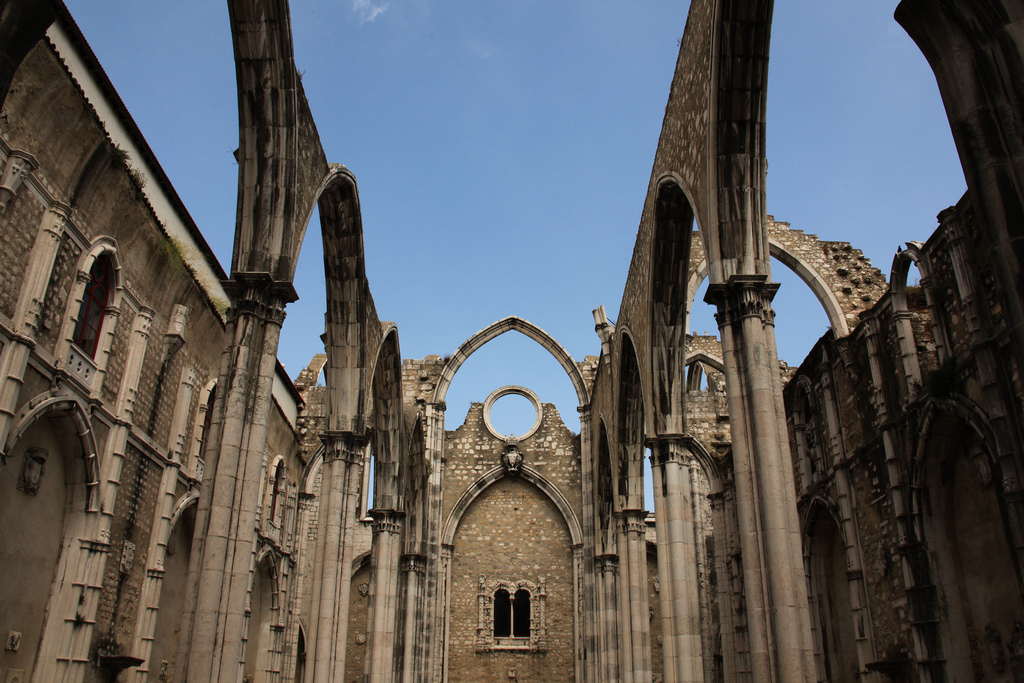
Poem by Ricardo Reis (Fernando Pessoa) from the collection “A Little Larger Than The Universe,” which I read in one sitting in a garden that I can’t recall the name of and can no longer find on the map. All I remember is a pond, some trees and a lot of large geese walking by my bench. I took the picture at the Carmo Convent ruins in Lisbon, which was destroyed by the great earthquake of 1755 and only partially rebuilt, creating an unusually intact complex of ruins. I’m not sure who Lydia is but I felt like Mr. Reis was speaking to me. I was facing another round of goodbyes and didn’t see any point in pretending there would always be another hang with friends whenever I liked; a wedding or reunion that would magically take place once everyone got caught up or settled in. Wait around too long and you’ll wind up as withered as the Peruvian mummy in the Carmo Convent museum. She’s a beaut, all right, but no one I’d trade places with.

F*** the Wetlands, we need a freeway

The title of this post is taken from a punk song written by my friend Jacob back in 2001. Though he meant it sarcastically (you might even say “sarcaustically”), the message has been party line for folks who have been trying for decades to build the South Lawrence Trafficway.

I was just reading today how the State of Kansas elected to to commit  $550 million to “fix” major traffic bottlenecks, including the aforemenioned route in Douglas County. As the above graphic illustrates, the South Lawrence Trafficway will cut right through the Haskell-Baker Wetlands, an extensive nature conservation area and ancestral burial ground of many of the region’s displaced Native Americans in the early 20th century. Even though the KC Star article eventually addressed the controversy, the headline in the second page read: “News elates Lawrence.”

Seriously? Lawrence is elated that the state is finally giving them the green light to bulldoze through the Wetlands? I guess it all depends on who you talk to.

Personally, I’m thrilled that Governor Sam Brownback was able to trim $689,000 from the budget by abolishing the Kansas Arts Commission right after he took office. I thought it was ridiculous how we supported artists, projects and festivals — many of which were in rural Kansas. I didn’t find it at all disturbing.

Ok, so I’m being sarcaustic again. And I have to acknowledge that part of job creation, maintaining the infrastructure, reducing debt, etc. involves making difficult choices. But it’s frustrating to watch us invest in half a billion dollar traffic projects instead of public transit. And it’s hard to watch my own state kill off its cultural assets for the sake of money.

But today, the victory belongs to the Mid-America Regional Council and the future of automobile transportation in the great state of Kansas. Hoorah! Without the impractical distractions of art and nature, the people of Kansas are elated.

But for how long?

(If you’d like a more friendly and artistic account of the Wetlands and its history, you can read this post from a couple years ago.)

Dreams of public transit, part 32

The other night I was riding on a tram somewhere in Greece, and I was just about to fall asleep when I looked behind me and saw a lady checking tickets. The other passengers held out their tickets and IDs but she didn’t even look at them, just walked by each person nodding and smiling. When she got to me I pulled out a pile of expired tickets and she said something I didn’t understand. Just then we pulled up to the next stop and she asked if I would like to step out to get some coffee. I couldn’t tell if I was being fined or not, but I went along anyway. She linked arms with me and we walked to an ice cream parlor (instead of a coffee shop, as initially suggested). I told her it was my treat and we spent a good half hour deciding what to get from the hundreds of unlabeled flavors presented in the glass case. I asked if she always went out for ice cream with fare jumpers and she said she only stopped passengers on trams that were headed to the airport, or to the sea. She mentioned going to the theater next but by that point I was concerned I would be missed at home. When I told her I had to leave she didn’t like it, but there was nothing she could do — I’d purchased my freedom with the price of the ice cream cone.

Biking back home

Riding my bike into KCMO the day after I get back, taking stock of the city and how much and how little it has changed. The laundromat on 43rd street has finally closed, most likely remaining in operation right up until the last of its 50 washers and driers finally bit the dust. The tattooed crowd outside the tattoo shop have not died of nicotine poisoning just yet. Blockbuster Video is somehow still in business, and the Westport covered wagon looks as regal and ready-for-takeoff as ever. Streetside has closed down but the red neon lights above the door are still turned on, as if the building is not yet ready to relinquish the life it once contained. Bikers in KC are much less rigid than those in Germany, making lazy figure eights across Westport road before picking a side street to pedal down. Two fat women in floral print dresses waddle out of Rudy’s taqueria, shouting to each other in voices that have only grown more hoarse over the last three or four decades. Crooked sidewalks with grass and weeds growing between them, the smell of freshly mowed lawns and truck exhaust. When visiting friends you don’t have to search for people’s name plates or doorbells on apartment buildings, you just park your bike and walk right up to their front doors. Dropping by unannounced isn’t done very much anymore, but I have an excuse as long as I don’t have a cell phone. There aren’t any bike lanes, but if you cheat on the traffic signals you can break ahead of the traffic and for a few glorious moments glide down the middle of the smooth paved streets until your survival instincts prompt you to front wheelie it up onto the sidewalk.

Teufelsberger Schloss

Though it has likely been observed and pointed out thousands of times already, it nonetheless bears repeating: the former allied spy station on top of the Teufelsberg looks like a giant cock-and-balls.

The remains of the station sit atop an 80-meter-high rubble hill in Berlin’s Grunewald forest, beneath which is buried the foundation of a Nazi officers school designed by Albert Speer. At the risk of mixing bodily metaphors, it’s hard not to wonder if the outpost’s phallic shape was designed as something of a middle finger to the Soviet forces on the other side of the city.

Sneaking into the Teufelsberg and climbing the radar towers has become something of a rite of passage for young Berliners, and a few years ago Jenny and I roamed around the premises until she got spooked by the howling sounds of the wind billowing through the torn fabric. On our visit last month we didn’t feel like trespassing, opting instead to just bask in the ballsy brilliance of this most peculiar cold-war monument.

No one seems to know what the future holds for the site, after attempts to develop it into a luxury hotel and a transcendental meditation center have long since been scrapped. Meanwhile the allure of the place only grows — an elegantly decaying fortress on the hill that is easily one of the most unusual erections in Europe.

Easter with Bonga

Jennifer and I got to Lisbon on Easter Sunday. We thought everything would be closed but there were several discount shoe stores doing a brisk business and a guy in a three-piece suit levitating above Rua Augusta.

That night we checked into This is Lisbon (awkwardly but not inaccurately referred to on their website as a “charm hostel”) where we were treated to (paid a nominal fee for) a dinner of traditional dishes and a performance of Brazilian music by a trio of guys the hostel employees were friends with. After the concert we talked with the musicians for a while and wound up accompanying them to a bar in the Alfama neighborhood, a labyrinthine remnant of Moorish times and one of the only areas in the city to survive the 1755 earthquake.

We stopped outside a door where a few people were smoking cigarettes but that was otherwise unremarkable. After Gonzalo pounded on the door a visibly drunken woman opened the door and ushered us in to a packed, steamy room where people were drinking and dancing to the sounds of some of the happiest, most uplifting music I ever heard. Two guys playing guitar and singing, another playing bass and a fourth playing percussion, if I remember correctly.

After they were finished the singer told me it was the music of Bonga, an Angolan who came to Portugal as a track star in the sixties but later turned to music, which got him in trouble with the Portuguese regime at that time. The next week I found a copy of his album Angola 74 at the Thieves Market, and was able to identify the song I heard as a cover of his song “Marika.” When you listen to it you might be able to get a taste of what for me was one of the most enjoyable Easters since the good Lord rose from the grave.

Karussel

Napping… without any church bells to mark the hours. Waking up and hitting the wordpress after seven months in Chateau D’If.

Now I’m back in Kansas and it’s time to get back to business. I have not posted here in the last few months for two main reasons. One, I did not have routine Internet access. Two, I was not sure exactly what to post in the first place.

In the past I have written about my life and travels in an amusing and somewhat journalistic fashion. This is what I did, this is something you should listen to, here are some photos and captions. All the time writing what are likely much more interesting or at least experimental things in various notebooks, loose sheets of paper, the walls of my sequestered, high-security compound.

It’s time to come out of the closet.

What I mean is there is no point in posting personal writing if it’s not going to be somewhat personal, no point in squirreling away the only nuts that might be worth hatching. But personal as in what I had for lunch is quite boring, and you can always get that on twitter. Persona as in the various modes and moods we all pass through each day, the in-between states in which actually interesting writing arises.

Of course blogging is all an experiment, and I must admit to being currently under the heavy, heady influence of the likes of Bernard Soares (whose city and dream states I just visited) and Joe Joubert (whose writing and nasal bridge I admire). I plan to vary the length of my posts but remain consistent in the frequency with which I post — daily, at least during the week, and sometimes probably more. The photos of Natalya Bond aka Jennifer Wetzel will still play a big part.

Please post comments, and feel free to be as contentious, uncomplimentary or long-winded as you like. I’m not posting on behalf of my ego, so you don’t need to comment just to tell me something is well-written if you don’t feel like it. On the other hand, I’m posting almost entirely on behalf of my ego, so I plan to be as arty and pretentious as possible when the occasion arises.

In conclusion, it’s good to be back in the Midwest, to be working in newspapers and publishing again, to have a high-speed connection between the inside and the outside worlds. I’ve always compared blogging to peering into and looking out of windows, so I’ll most likely be talking and linking back to you as well.

Love from Westwood, and good to see you again.

LW

Postcards from Europaplatz

Monday mornings I teach lessons at an office park in Erfurt that always seems to be covered in fog or frost. To get there you have to ride all the way to Europaplatz, the end station on tram lines #1 and #3. Going to work at an office complex in a foggy valley at the end of a small East German city probably sounds depressing, but I enjoy it. The free coffee helps. And also knowing that even though I start at 8:00 on Monday morning, my work week there lasts only a few hours.

Across from the building I work in is a field, and on the other end of that field is a McDonalds. The McDonalds is just off a highway exit and seems fairly inaccessible by foot unless you go crashing directly through the field — a misty, frosted terrain full of burger wrappers and what look like tumbleweeds. I was pretty hungry one day and thought about making the trek, but the idea of stumbling into the foggy wilderness to get to the golden arches seemed too obvious and poignant a symbol for a lost American boy trying to get home. In those conditions the giant “M” might as well have stood for “Mirage.” So, I turned around, caught the tram back into town, and ate at the McDonalds in the central train station instead.

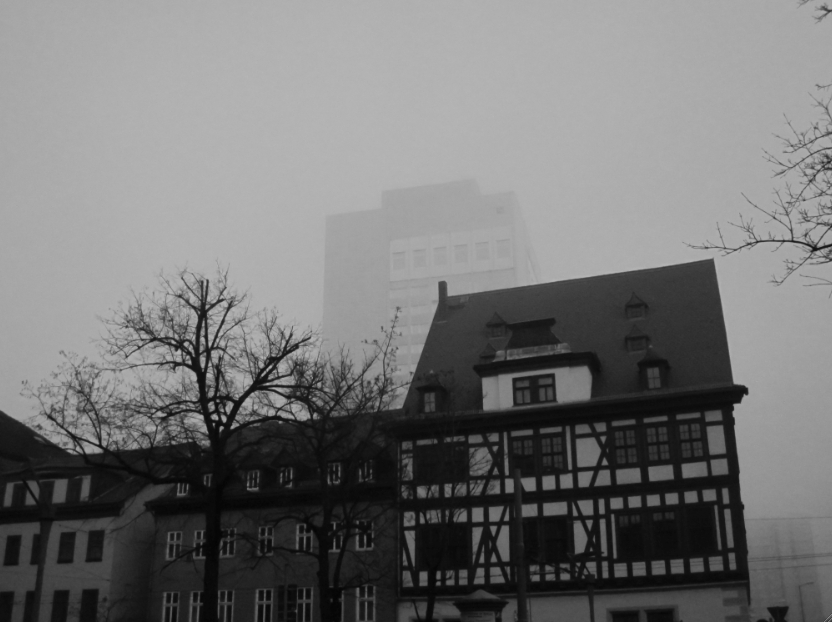
On the way there I saw this juxtaposition of buildings — a boxy modern structure behind a timbered house. Not a bad summing up of the architectural coexistence of the middle ages and the DDR.

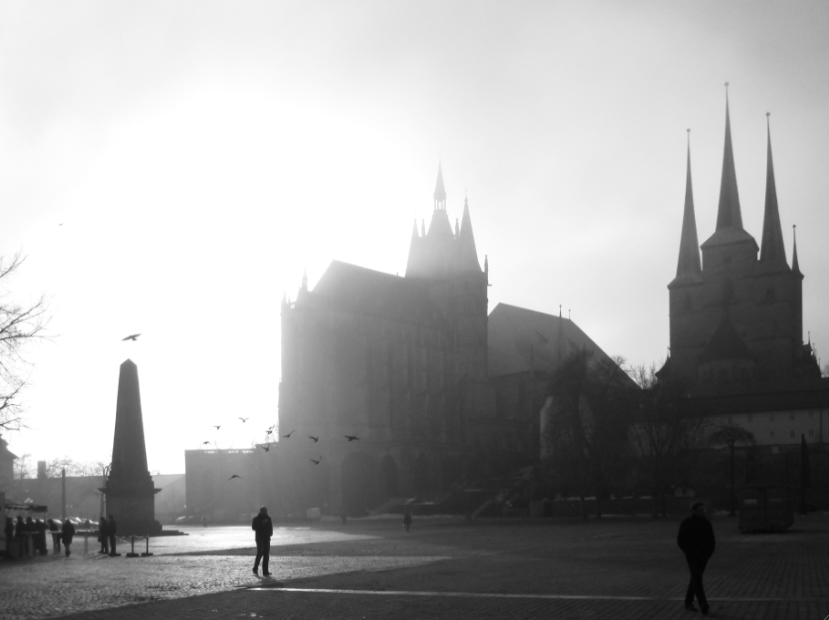
And to close, a more classic shot — the Cathedral Square at a moment of extreme fog and sun, birds flying over the monument and a line of people at the Thüringer Rostbratwurst stand.

Brocken Harz club

Charging to the top of the Brocken / Where what once was broken / Can be forgotten

This fragment is my contribution to the wealth of literature about Germany’s most mysterious mountaintop, the Brocken. Most mentions include depictions of the witches’ revelry on Walpurgisnacht, such as in Goethe’s “Faust,” but I didn’t see any witches myself. Just a bunch of tourists stumbling through the freezing fog.

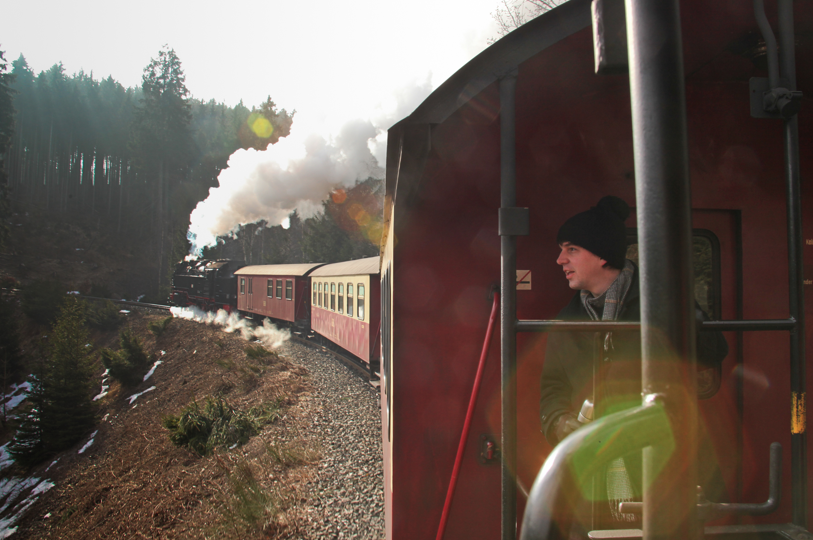
Jenn and I decided to visit the peak on my 30th birthday, ascending via narrow-gauge steam railway, a 19 km ride from Wernigerode that took almost two hours. Most of the journey offered clear views of the surroundings, but when we got to the top we found we couldn’t see anything. The red-and-white television tower — home of a Soviet spy station in the cold war times — was almost completely hidden from view, which was amusing considering you can usually see the thing from dozens of miles away.

Instead of scenes from Goethe’s Faust, I reflected on Thomas Mann’s “Doktor Faustus,” which I finished reading last month. The book contains very little overt occultism, instead raising some disturbing questions about the artistic process. Must one really sell one’s soul to complete a work of true genius? Such is the case for Mann’s composer character Adrian, whose speech at the end is so tragic and ridiculous it makes the preceding 500 pages well worth it.

Me? I’d rather be a minor poet, slugging Hasseroder Pils from the platform of the rickety old train, speeding toward a dinner of farmer’s potatoes and bacon in a cosy restaurant near the town’s famous rathaus.

Thanks everyone for the kind birthday wishes (especially Private Cho calling from the Korean Border!) and I will be in touch with more e-mails and posts soon. In the meantime, you can see more pictures of the journey here.

Tear them down and paint them over

Though Berlin natives and resident ex-pats often write it off as a schmaltzy tourist attraction that hasn’t held up over the years, The East Side Gallery is still a lively, colorful representation of the city’s divided history. Last week Jennifer put together a slideshow of some of the paintings, which were created by artists from all over the world. As she said on her website:

The photographs displayed in the slideshow are not a complete representation of each section of the gallery, but instead a selection of a few personal favorites, chosen because of a particular composition or color pattern. The former presence of the wall, mentally and socially, becomes less and less apparent over time…

It’s neat to look at this over 20 years after the wall came down, especially in light of the revolutions currently taking place in the Arab world. It’s as if the same peaceful populist spirit that brought the iron curtain down has shifted to the Mideast, and I’ve noticed that people here share the excitement and are paying close attention, as are so many others around the world.

Hope this brightens your Monday, and more later in the week.

Letter from the (former) editor: 15 steps for avoiding Web media failure

Although I resigned my post as editor and co-founder of KCFreePress.com back in May 2010, I never took any real opportunity to explain why. But being away for a while has given me some perspective on the experience, so I thought I’d take the time to talk about what happened at KCFP and what I learned from the whole thing.

For those of you who didn’t visit the site during its short tenure, KCFP was an online publication launched by Jeff Henry, the owner of BigShot marketing and a former Pitch sales guy who always wanted to create something similar on his own terms. I was introduced to Jeff through a colleague at Universal Press and quickly went about outlining the site and recruiting different people to take part, including executive editor Jay Senter (who now publishes PVPost.com) and Emily Farris, a talented freelance writer for several national sites.

With the help of about two dozen freelancers, we launched a site that focused on a wide range of local news and events, publishing about 20 stories a week along with photo galleries, video features, polls and an extensive events calendar. Though the initial efforts were met with enthusiasm, solid readership and a genuine belief that we were doing something new, financial issues and lack of resources caught up with us rather quickly. After the last of the initial crew quit last summer, the site stayed up under Jeff’s leadership until someone finally flipped the switch in October 2010.

Though KCFP was unsuccessful on many levels, the experience was highly educational, and it’s with that spirit that I’d like to offer these 15 hard-earned guidelines for anyone wishing to enter the wild world of local online publishing.

Continue reading “Letter from the (former) editor: 15 steps for avoiding Web media failure”

Sketches from the morning commute

* * *

After leaving the party we turn the corner to Schlesisches Tor and hear what sounds like a live gypsy band with horns and drums and everything. Inside the station, a full-blown cabaret is underway, the likes of which Berlin hasn’t seen since 1929. People lock arms and dance jigs and hoist their beers and clap in rhythm, all at 2:30 in the morning. But by the time I’ve bought a beer at the station shop, the music has already stopped. Cops pile out of paddy-wagons on either side of the station, and as the crowd boos and begins to disperse a girl hands out fliers.

* * *

On the way to catch the 4:45 a.m. train to Erfurt, I walk by the Trinkteuffel, the Kreuzberg corner bar where the patrons sit and drink their beers with the same casual nature you’d expect at a nice Sunday afternoon cafe. Further down the street I see a man slipping all over the ice, which is pretty thick at the moment. He’s having a hard time keeping his balance, and I feel sorry for him until I notice he’s just really, really wasted.

* * *

Still dark outside, and it looks like I’m the only one awake on this ride to Alexanderplatz. Everyone else is sprawled out on the benches with their eyes shut and their mouths open. When the U-Bahn turns a corner, however, I catch a glimpse of at least one other awake soul — a girl a few cars down waving her arms in half-windmills and tossing her pink-streaked hair from side to side. Nobody bothers to tell her she’s no longer at the dance club. But, nobody seems to mind.

* * *

At the back of the tram to Europaplatz, the teenage Mutti watches over the stroller while Papa strides toward the ticket machine in the front car, taking his hands out of the pockets of his black hoodie to steady himself against the swaying of the tram.

* * *

On a cold Friday afternoon on Kotbusser Dam, a girl with frizzy hair and a red-and-white jacket juggles juggling pins at the stoplight. She drops them several times but still has the nerve to jog between the cars and wave a change basket before the light changes. Nobody obliges, and I wonder if anyone else is missing the fire-breather who set up shop there last week.

* * *

Just before dawn along the cobblestone street to Südplatz, a lady in high leather boots, a ski coat and jewelry shuts the car door and steps toward the door of her building. I’m on my way out the door to work and she’s just arriving home. I know where you’re going and you know where I’ve been.

* * *

At Mehringdamm an old man in a long black coat tries to step out of the U-Bahn just as the red lights flash and atonal bleeps sound in alert. The doors close halfway on him, but he manages to free himself by prying them back open with long, spindly fingers, gasping as he steps out into the station. His face is as pale as Nosferatu, and we can’t help but think we might have just witnessed something release itself from the underworld.

* * *

A few minutes until 6 outside Leipzig Central Station, and dozens of bakery employees in red jackets huddle in clusters and smoke cigarettes outside the exits, puffing with the urgency of people who think they might be smoking the last cigarettes of their lives.

* * *

Here comes a headache, I think as I watch a trio of guys lug instruments and a mobile p.a. onto our midnight car to Kotti. But once they start playing — saxophone, melodica and beats — everyone starts clapping and singing along to “Hit the Road Jack.” Even the sullen kid across from me puts down his book and lets out a tiny smile. When someone shouts for an encore the band launches into the first few bars of “When the Saints Go Marching In.” And when the train lurches and pulls everyone into each other, the dancing kids do their best to keep their beers from spilling.

* * *

On the morning commute, I being to realize I’m the only one on the U-Bahn not wearing a black top and blue jeans. After a few stops I start to feel like a corduroy-clad crasher of their impromptu denim convention. The jeans themselves come in all varieties: The man on my right has opted for dark and distressed, while the woman beside him sports a lighter shade of stonewashed.

* * *

Riding though the Saale in January, I see for the first time the cupolas of churches and houses of a hillside village built around a valley waterway. I marvel at how closely the buildings are intertwined with the river until I realize that it isn’t supposed to be this way; that the town is half-flooded.

* * *

As the tram nears a stop, a young couple embraces in what looks like a very passionate farewell. When the doors open, the man behind them waits calmly for the couple to finish instead of pushing his way past. It looks like they are saying goodbye for a long time, he probably thinks. But when their lingering kiss finally ends, they join hands and walk off the tram together.

* * *

Author’s note:

As a journeyman English teacher, I do a lot of transit riding. In fact, yesterday I had to get up before 5 to catch a train to the central German city of Erfurt, where I teach three classes at Siemens. I teach at different schools and businesses in Leipzig, and before moving here I had to race all over Berlin to take class, meet friends, and collect various visa papers and stamps. I can barely sit down without expecting the scenery out the window to begin moving at any moment.

What makes the commute interesting is not just the time I get to sleep, read or stare out the window, it’s the fellow passengers and people I observe along the way. The other day I compiled this little people-watching catalog from my rides to and from class these last few months. I was going to upload this from the train for extra style points but the connection on “das Internet Stick” was too slow.

This one goes out to all of my fellow U-bahn Ratzen and tram travelers, and to especially to Jenny, who has a long voyage ahead of her tomorrow to get back to her man. I welcome any feedback or and it would be extra fun if anyone wants to chime in with their own transit observations in the comments. Love, LW

The Kreuzberger Garbagegoyle

Berlin is a land of many visual wonders, perhaps none quite as simultaneously functional and artistic as this sculptural garbage can in the middle of Lausitzer Platz. We found this guy in the park where several dozen kids were playing on the swings and jungle gym. None of them went anywhere close to it, though, which probably explains why he looks so bored and lonely, snow dusting his nose and gaping mouth reeking faintly of yesterday’s stale wine and cigarettes.

Poor chap.

Kansas turns 150

My home state celebrated a big birthday today. Kansas is now one-hundred and fifty years young. Even though I suspect it has been around a lot longer than that. Just ask Juan de Oñates, who in the early 1600s referred to the native Kansans Escansaques, “the troublesome people.” Not much changes, I suspect. And also thank Case Seward for this centennial illustration of the opportunities that await you once you make that decision to don a garland of sunflowers.

See you all in Kansas sometime soon. Meanwhile, more vintage KS postcards here.

The Flaming Teabags


“The Flaming Teabags,” (or for you Germans, die Flammende Teebeutel) sounds like the name of a band. And perhaps it is. Or has been. Or could be. It’s also a parlour trick perfected by Till, which James documented one winter night at our flat. Note to viewers — and I mean this — do not try this yourself. Till has a touch that I’ve found myself unable to replicate, much to the detriment of the kitchen table.

My year behind glass

I first got inspired to shoot short, observational video clips after watching my old neighbor Blue McNiel’s “A 43rd and Warwick Story.” In 3 minutes and 2 seconds, virtually nothing happens aside from the lights changing and some cars driving by while the camera watches from her front porch. I had pretty much the same view at the time, and I remember the sounds of the lights clicking and the green- and red-outlined shadows they would cast through my curtains onto my ground-floor bedroom. The document has taken on a historical importance now that the lights have been replaced by stop signs and I have moved away.

I started shooting similar observational clips out of windows, on front porches, at parks and art exhibits. My montage could be called “A 2010 Story” or “A Kansas City Story” although this timeframe and location has to be expanded to account for a wee bit of Mississippi and Europe. It’s a just over 2-minute trip across flooded and frozen landscapes, Christmas carols, full moons and orange balloons.

Nothing that’s going to break down any doors, but you might enjoy it all the same.

Restoring Schönholz


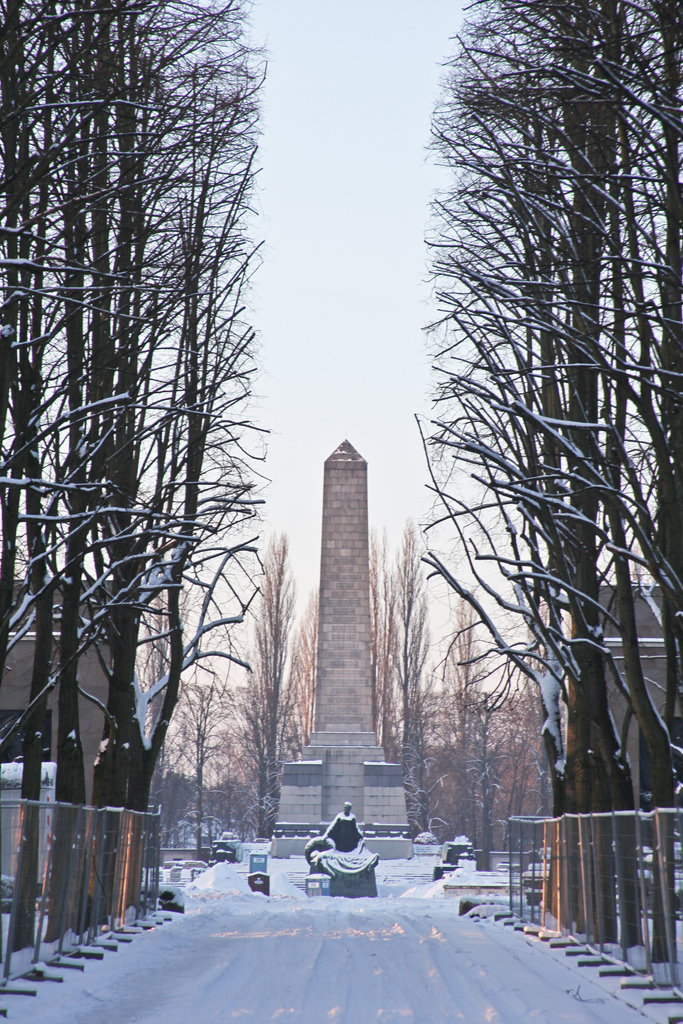
A few weeks ago I finally went to visit the Soviet Memorial in the Schönholzer Heide in the northeast of Berlin. I first saw the landmark in the film “The Lives of Others” during the scene where the main character and his dissident friend seek out a spot to stroll and talk unobserved. I’ve been wanting to visit ever since.

Approaching the snow-covered obelisk and mourning Mother Russia statue on that gray winter afternoon proved every bit as cinematic as the scene in the film. Unfortunately you couldn’t get closer than 100 yards of the memorial because of the construction fences all around it. Stacks of tiles and scattered port-a-potties stood guard around Mother Russia, and the sign said restoration would be taking place until 2012.

Even from that distance, the Schönholzer memorial has a completely different atmosphere than the tank in the Tiergarten or the mighty monument in Treptow, which features a giant statue of a soldier crushing a swastika under a sword while rescuing an orphan child. The main statue at Schönholz is of a kneeling woman cradling her fallen son on her lap. It expresses loss and solemnity — intimations only amplified by the vacant, snow-covered surroundings that afternoon.

We walked around the perimeter but could see very little over the foreboding border wall, which still had the hooks for the banners and flags that must have once decorated it on ceremonious occasions. I wanted to sneak in, but since there are over 1,000 soldiers buried there, one must enter the place with a level of respect that is difficult to achieve when trespassing.

Still, I’d come a long way, and I didn’t think getting a closer look would cause any real harm as long as I was careful. Just outside the marble gates I found a gap in the fence wide enough to step through. I took a few steps and looked around before beating a hasty retreat, like a mouse scurrying back into its hole after getting the sudden sensation it isn’t safe. I peeked back around the construction trailer into the center courtyard. Now or never. I started back in only to look up and see this…

…a definite sign I should go no further.

So I went home. Like everyone else, I’ll just have to come back after the restoration is finished.

I suspect some of the drab, overgrown quality that attracts me to the place will be scrubbed away in the restoration process. Still, the Schönholzer Heide has been through a lot in the last 100 years, serving as a forest grounds, amusement park, internment camp, and today, a sled-friendly park sprinkled with monuments like the Soviet Memorial. It deserves to be seen in a new light.

Oranienstraße im Flammen

Here in Germany, they call New Year’s Eve “Silvester,” named after Sylvester I, who was Pope from 31 January 314 to 31 December 335. Each December 31 they celebrate the old Roman’s legacy — and the new year — by blowing up everything in sight (see my post from two weeks ago).

Below is yet another fireworks video, this time depicting a Silvester street scene on Oranienstraße, near Oranienplatz. We narrowly dodged a few rockets fired from the Kreuzberg Sportwettenbruecke, and thankfully managed to steer clear of the Mercedes that caught on fire over on Koepenickerstraße.

At midnight, under the relative shelter of the awning at the Santa Maria Mexican Diner, we sipped our beers and watched the city spark itself into a jubilant chaos. Rockets, flare guns, and sparklers, shot off by people on the streets and leaning out of upper-story windows. Quite noisy and fantastic. The only thing more impressive was the mess it left the next day.

‘Like hell comin’ out of the pavement’

I don’t upload a lot of things to YouTube, but it seems like when I do it’s always something about fireworks. Like this pyramid-of-snakes burning ritual in the parking lot at Herbert’s Mart strip mall, located squarely in the middle of Wayne County, Mississippi. While working in the fireworks stand there, Brian and I befriended a local high school graduate named Tom. Due to his athletic and amorous pursuits in and Waynesboro — most specifically that very strip mall parking lot in which we sat and drank beer — Tom had been dubbed “The King of Herbert’s Mart” by his peers. A widely recruited placekicker who was injured early in his senior season, Tom spent most of his time drinking beer, getting in fights, cruising the strip and fixing cars at WalMart. He was a welcoming and friendly guy, and told some amazing stories about life in Wayne County, which he called “The Land of Dreams.” I’ll share more about him another time. For now, some footage of the aforementioned smoldering snakepile, with commentary by the King of Herbet’s Mart himself…

Reichenberger Gasbeleuchtung

Walking down Reichenberger Straße, Adam and Rasto fall into a debate about whether the lamps are gas or electric. Adam says they are gas, and Rasto doesn’t believe him.

“Gaslamps have a certain sound,” Rasto says. He stops next to one of them to listen. “It sounds like gas,” he says skeptically.

We walk another block.

“If it’s gas, you should be able to make them turn on or off by kicking them,” Rasto says. He kicks a dark lamppost and watches it come on. He kicks another one and nothing happens. “It could be gas,” he says.

We keep on walking.

Adam then points out that gas lamps give off a warmer, more amber color. Rasto agrees and goes in for a closer look, stepping on top of a snow-covered bicycle to hoist himself halfway up the lamppost. He shakes the pole and watches the lamp-light flicker, his eyes lighting up with this brightness of his discovery.

And he yells:

“It’s fucking GAS!

(photo of the Gaslaternen Freilichtmuseum in the Tiergarten, which we visited last week. More Berliner gaslamp history here.)